Kearsarge
Peg Co., Inc. is a business located in Bartlett, NH
that has been in continuous operation in this
location for 121 years. The company has prospered
through the years on its reputation for quality
products and timely delivery. The original product
(hardwood shoe pegs and hardwood tumbling media) is
still manufactured in the facility, and in fact,
Kearsarge is the only manufacturer of this product
in North America. In the 1980’s the company started
a research and development effort to diversify its
product line. This effort produced the “PEGCO
Process Laboratories Division”, a subsidiary with a
number of activities related to abrasive tumbling
and metal finishing. This PEGCO division currently
manufactures a wide variety of abrasive materials
that are used in conjunction with hardwood tumbling
media. The division also maintains a process
laboratory that solicits metal finishing problems
from customers, and then develops processes using
aerials made by PEGCO, along with others, and
machinery that PEGCO offers for sale.
The company was established in 1865 in
Andover, NH by Gerry and Augustus Morgan and
the Baker,
Carr &
Sons Co. Sometime later Baker, Carr & Sons’
interest appears to have been purchased by
Jacob R. foster and he along with the Morgan
brothers moved the Kearsarge Peg Co.
operations to Bartlett, NH in 1878. (A
Portland Locomotive and Marine Engine Works
steam engine, [with an 1878 manufacturer's
nameplate] was the primary energy source for
the factory operations up until its
retirement in the 1980’s. The steam engine
is now currently housed and operational at
the Maine State Museum in Augusta, ME.) The
two Morgan brothers purchased Mr. Foster’s
interest in the business, and ran the
business until a fire destroyed the plant in
1905.
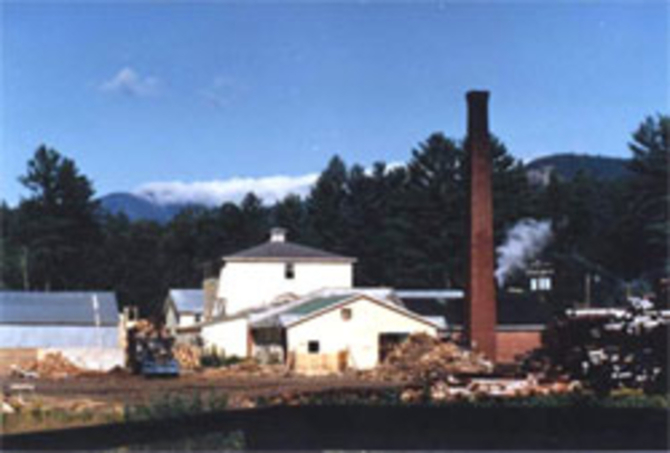
(Pictured Above:View
of Kearsarge Peg Co. in 1920, the white birch seen
here was favored for making specialty hardwood shoe
pegs. The
primary market for the company's
product at this time was the shoe industry.)
At this time, the trademarks
and goodwill of the business were purchased
by Edwin and George Foster (sons of the
Jacob mentioned above) who rebuilt and
operated the plant from 1911 until it was
purchased by Stanley E. Davidson and Francis
L. Brannen in 1944. These two operated the
Bartlett facility until Mr. Brannen’s death
in 1962, whereupon Mr. Davidson became the
sole owner.
In 1966, the firm was
incorporated in the State of New Hampshire with
Stanley E. Davidson Sr., as President and
Stanley E. Davidson Jr. as Vice President. This
arrangement continued until 1979 when Mr.
Davidson Sr. retired and the corporation
redeemed his stock, Leaving Mr. Davidson Jr. as
the sole stockholder of the corporation.
The principal business of the
company at its inception was the manufacture of
shoe pegs. Shoe pegs were long cross sectioned
hardwood shapes with a point on one end,
manufactured primarily from white, yellow and
silver birch, although white maple and beech are
occasionally employed as well.
The Kearsarge Peg Co. manufactured
approximately seventy-five different sizes of
shoe pegs, which varied in size from 5/16 in.
long by 1/18 in. wide to ¼ in. wide by 2.0 in.
long . This product was used as a component of
shoe manufacturing in the nineteenth and early
twentieth century, and replaced shoe nails, as a
means for insuring a lasting bond between the
last and sole of the shoe. It was considered
superior to metal nails, in that over time the
wood peg would draw moisture from the ambient
atmosphere and swell, forming a lock fit between
these two components.
Shoe manufacturing along with textiles
was a major segment of the economy of New
England at this time, and there were dozens of
plants, which made this product in competition
with Kearsarge. In its earlier years, Kearsarge
exported heavily to the shoe industry in Norway,
Germany, Australia and elsewhere. The last
existing competitor in North America, the Moore
Peg Co., in Lisbon, NH was lost in a fire in
1949. This company (Moore) had been owned by the
Lupoline Corporation in Bronx, New York which
was a pioneer in the use of natural materials,
including wood pegs as a tumbling and final
finishing medium for the plastics, jewelry and
precision metalworking industries.
The use of pegs in
shoe manufacturing came to an abrupt
halt with the advent of the Second
World War. (Exception: custom made
climbing, skiing and cowboy boots).
Not only did the company find that
its export markets were now closed,
but new developments in shoe
manufacturing technology obviated
the need for pegs to tie or lock the
last and sole of shoes together.
Lupoline, under the
director of its founder Joseph Lupo of
pioneered dry barrel finish or tumbling
techniques in the early part of the
twentieth century, with some patents
dating as early as the 1920’s and
1930’s. He found that “shoe pegs” made
an ideal mass finishing media for
smoothing and polishing plastic parts in
rotary barrel finish equipment. This
technology was quickly adapted by major
manufacturers such as Bausch & Lomb,
Foster-Grant and the American Optical
Co. and others to replace tedious manual
finishing methods that involved buffing.
These large manufacturers of eyeglass
frame and sunglass frame components were
soon utilizing hardwood pegs in bulk, by
the truck load and even car load for
abrasive finishing and polishing
operations. This continues to be the
primary use for hardwood pegs and other
hardwood preform shapes that the company
manufactures to this day.
In the early
1980’s the company management
decided that there was a need to
become more involved on a
technical level with the
finishing industry. As a result
the PEGCO Division was
instituted as a marketing and
technical arm to more
aggressively market hardwood
media for other applications. It
soon became apparent that there
was a need to make PEGCO a
technical resource for the
finishing industry. Its focus
became providing technical
solutions to difficult edge and
surface finish problems by
process development in its
“process laboratory” and
offering turn-key equipment and
abrasive supply packages as the
solutions to these problems.
The
company’s office and
manufacturing facilities
are found at the same
location in Bartlett,
NH. These facilities are
comprised of
approximately 25,000
square feet of
manufacturing and
warehouse space
encompassed in an eleven
building complex,
situated on seven acres
bounded by Kearsarge
Street and the White
Mountain National Forest
14
Mill Street, PO
Box 248 Bartlett, NH. 03812
Phone:
603.374.2341
Fax:
603.374.2366
|
|